





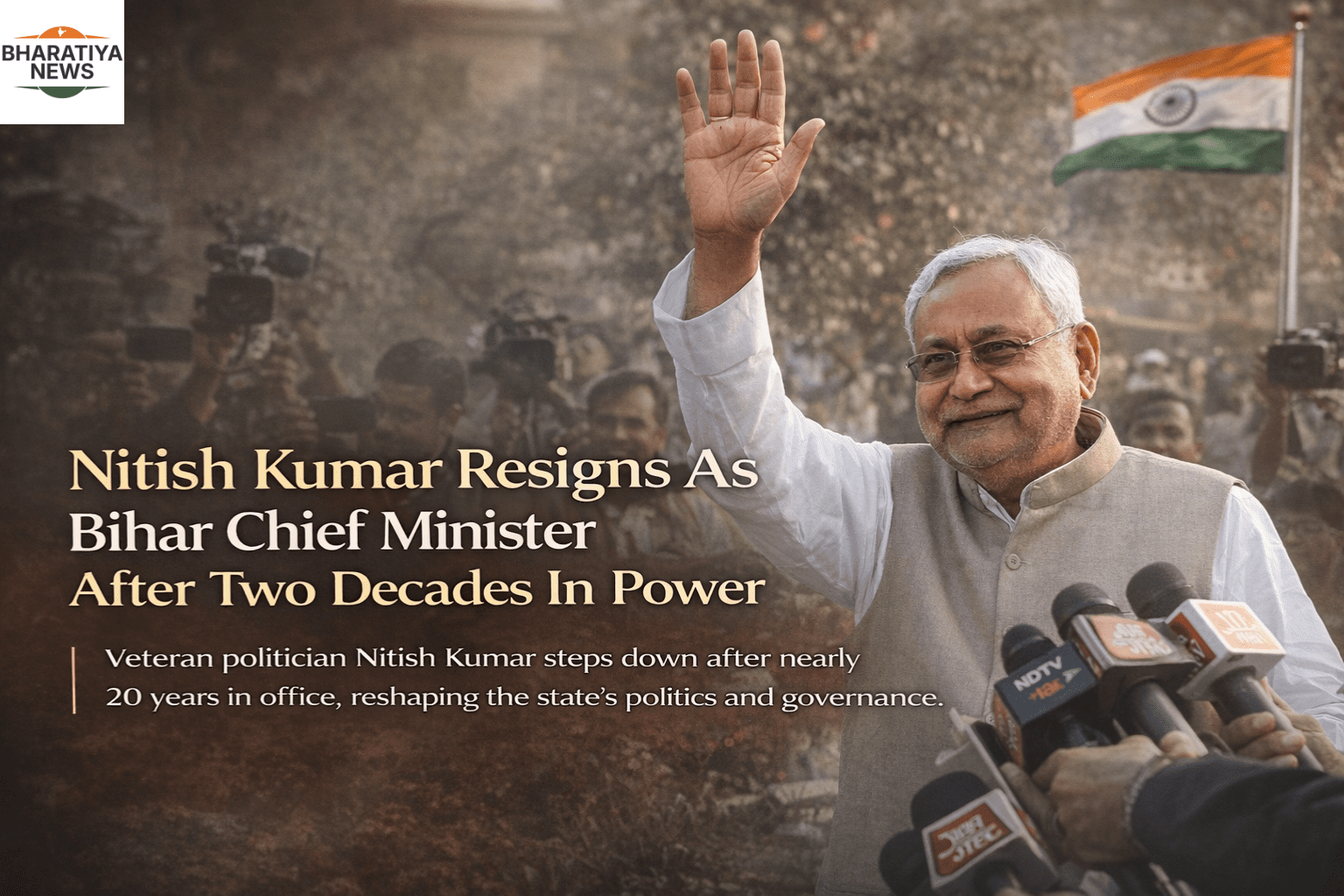
Nitish Kumar Resigns As Bihar Chief Minister After Two Decades In Power
Patna, March 6:
Veteran politician Nitish Kumar has stepped down as Chief Minister of Bihar, bringing an end to a political journey that reshaped the state’s governance over nearly two decades. The move comes shortly after his party secured another electoral victory in the December 2025 Assembly elections and ahead of his expected transition to the Rajya Sabha.
The resignation marks the end of one of the longest and most influential chief ministerial tenures in Bihar’s political history. It also signals a major shift in the state’s political landscape, as Bihar is set to have a Chief Minister from the Bharatiya Janata Party for the first time.
A Political Career Defined By Longevity
Over the years, Nitish Kumar served as Chief Minister ten times, earning a reputation for strategic political maneuvering and coalition-building. His tenure was defined by a mix of governance reforms, social engineering, and shifting political alliances that kept him at the centre of Bihar politics for over 20 years.
Often referred to as “Sushasan Babu,” Kumar built his political identity around promises of improved governance, law and order, and infrastructure development in a state that had struggled with administrative challenges in the past.
Governance And Infrastructure Push
When Kumar assumed office in 2005 with the support of the BJP-led National Democratic Alliance, Bihar was grappling with weak law enforcement and deteriorating infrastructure.
His government launched a series of reforms aimed at strengthening the judicial and policing systems, reducing crime, and restoring public confidence in state institutions. The administration also prioritised road construction, electrification, and improved connectivity across the state.
These measures helped reshape Bihar’s governance narrative and strengthened Kumar’s reputation as a reform-oriented leader.
Social Engineering Strategy
A key pillar of Kumar’s political success was his strategy of social inclusion. Recognising the strong voter base of rival leader Lalu Prasad Yadav among Yadav communities, Kumar focused on consolidating support among other marginalised groups.
He introduced targeted welfare policies for Extremely Backward Classes (EBCs) and the most disadvantaged Dalit communities, referred to as “Mahadalits.” These groups collectively represented a significant portion of the state’s population and became a loyal support base for Kumar’s Janata Dal (United).
Women-Centric Policies
Another defining feature of Kumar’s governance model was his focus on women’s empowerment. Programs such as free bicycles and uniforms for schoolgirls aimed to increase female education and participation in public life.
One of his most controversial yet politically impactful decisions was the implementation of prohibition in Bihar. The policy banned the sale and consumption of alcohol in the state. Although critics argued it reduced government revenue, the measure gained strong support among women voters who associated it with improved household stability and reduced domestic violence.
Women voters subsequently became one of Kumar’s most dependable electoral bases.
A Career Marked By Political Flexibility
Nitish Kumar’s career was also characterised by frequent alliance shifts between rival political blocs. Over the years, he alternated alliances between the BJP-led NDA and the opposition Mahagathbandhan, which included parties like the Rashtriya Janata Dal and the Indian National Congress.
His critics often labelled him “Paltu Kumar” for these switches, while supporters described him as a pragmatic survivor capable of navigating complex political realities.
Despite the criticism, Kumar repeatedly returned to power, demonstrating remarkable resilience in Bihar’s highly competitive political environment.
End Of An Era In Bihar Politics
With his resignation, Bihar closes a significant chapter in its political history. Nitish Kumar’s tenure left a lasting impact on governance, social policy, and coalition politics in the state.
As he prepares for a new role in national politics through the Rajya Sabha, the leadership transition in Bihar will be closely watched for its implications on the state’s political future and governance trajectory.