



“War Has Costs”: Iran Charges $2 Million Toll On Ships Crossing Strait Of Hormuz
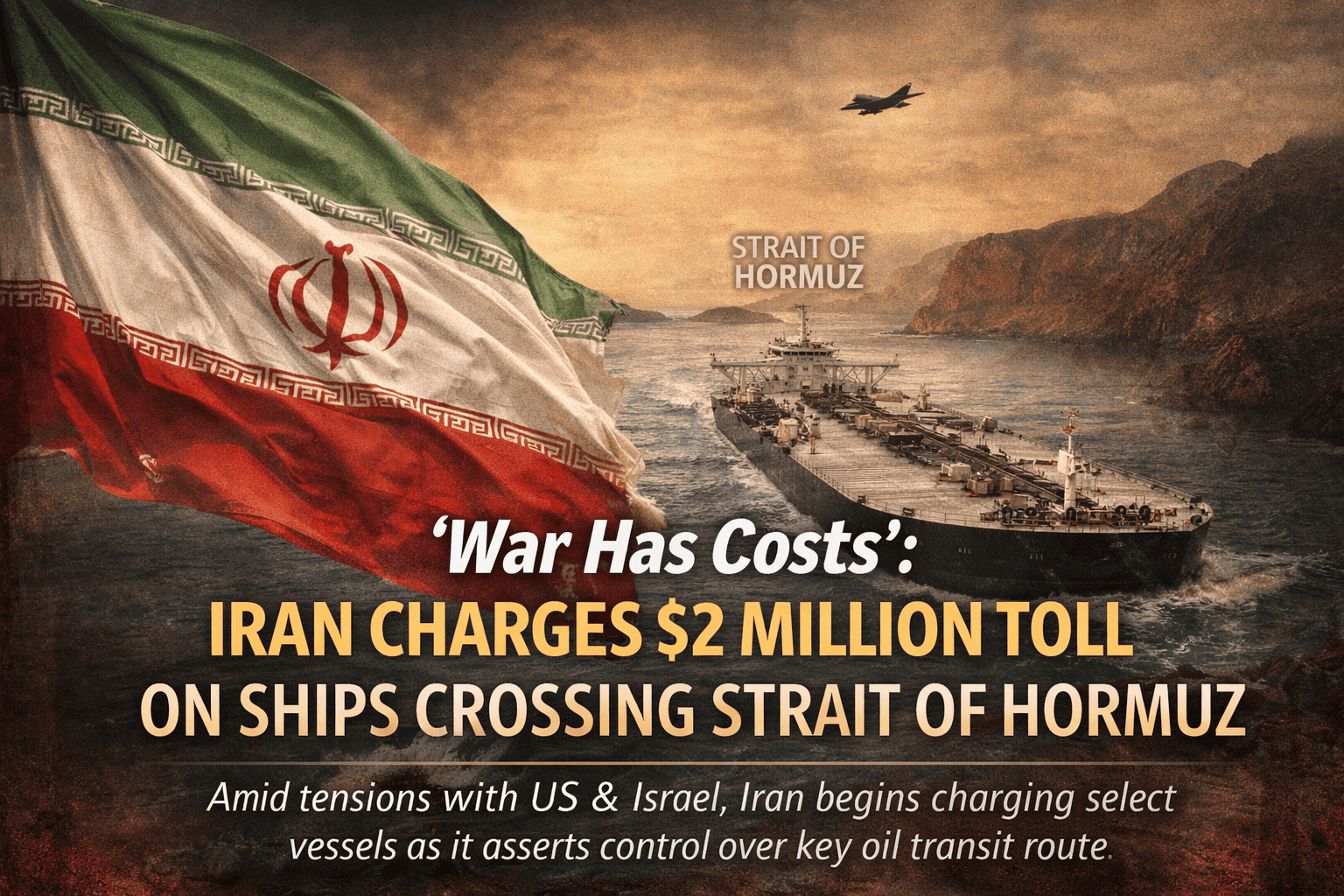
Amid escalating tensions in the Middle East, Iran has announced a controversial move to charge up to $2 million (approx. ₹18.8 crore) from select vessels passing through the strategically vital Strait of Hormuz, one of the world’s most crucial oil transit routes.
The decision comes during the ongoing conflict involving United States and Israel, as Tehran seeks to assert greater control over the key maritime chokepoint.
“War Has Costs”: Iran Justifies Move
Iranian lawmaker Alaeddin Boroujerdi, a member of the national security committee, confirmed that the toll has already been implemented. Speaking to state broadcaster Islamic Republic of Iran Broadcasting, he described the move as a reflection of Iran’s strength and sovereignty.
“War has costs… naturally we must take transit fees from ships passing through the Strait of Hormuz,” Boroujerdi said.
He added that the policy signals a new “sovereign regime” in the strait after decades.
Strategic Importance of the Strait
The Strait of Hormuz is a narrow but critical waterway connecting the Persian Gulf to global markets. Nearly one-fifth of the world’s oil supply passes through it, making any disruption a major concern for global energy markets.
Recent hostilities and attacks on vessels have already slowed tanker traffic significantly, raising fears of supply shocks and rising oil prices worldwide.
Rising Tensions With the US
The announcement follows sharp warnings from former US President Donald Trump, who threatened military action if Iran failed to keep the strait open.
The US could target Iran’s major power plants if access is blocked, Trump warned.
In response, Iranian officials stated that they could retaliate by targeting key infrastructure in Israel, escalating concerns of a broader regional conflict.
Iran’s Official Stand
Iranian President Masoud Pezeshkian defended the country’s stance, stating that the waterway remains accessible—but with conditions.
“The Strait of Hormuz is open to everyone except those who violate our soil,” he said in a statement on X.
Tehran has also warned that the strait could be completely closed if the United States proceeds with any military strikes.
Global Impact and Uncertainty
With tensions rising and shipping routes under pressure, the situation in the Strait of Hormuz is being closely monitored by global markets and governments alike.
Any prolonged disruption could have far-reaching consequences, including spikes in oil prices, supply chain disruptions, and heightened geopolitical instability.